How much do piano lessons cost
- Price of a full term
- $420
- Computed on this page from the inputs below
- The same rate for a half hour
- $35
- Computed on this page from the inputs below
- The same rate for a full hour
- $70
- Computed on this page from the inputs below
- Paid to the teacher, per lesson
- $21
- Computed on this page from the inputs below
Every figure on this site comes from the numbers you enter and the method printed beside them: your lesson length, your term weeks, your rate, your teacher split, your room cost and your travel. Where a guide names a published document it names the document and the date it was read. This site publishes no teacher's prices and no studio's fees.
Email me this result
We will send you these figures and a link back to them. One email, nothing else unless you tick the box.
The figures shown are a worked example for a small teaching studio: $420. Change them for yours.
Download the How much do piano lessons cost worked example (CSV)
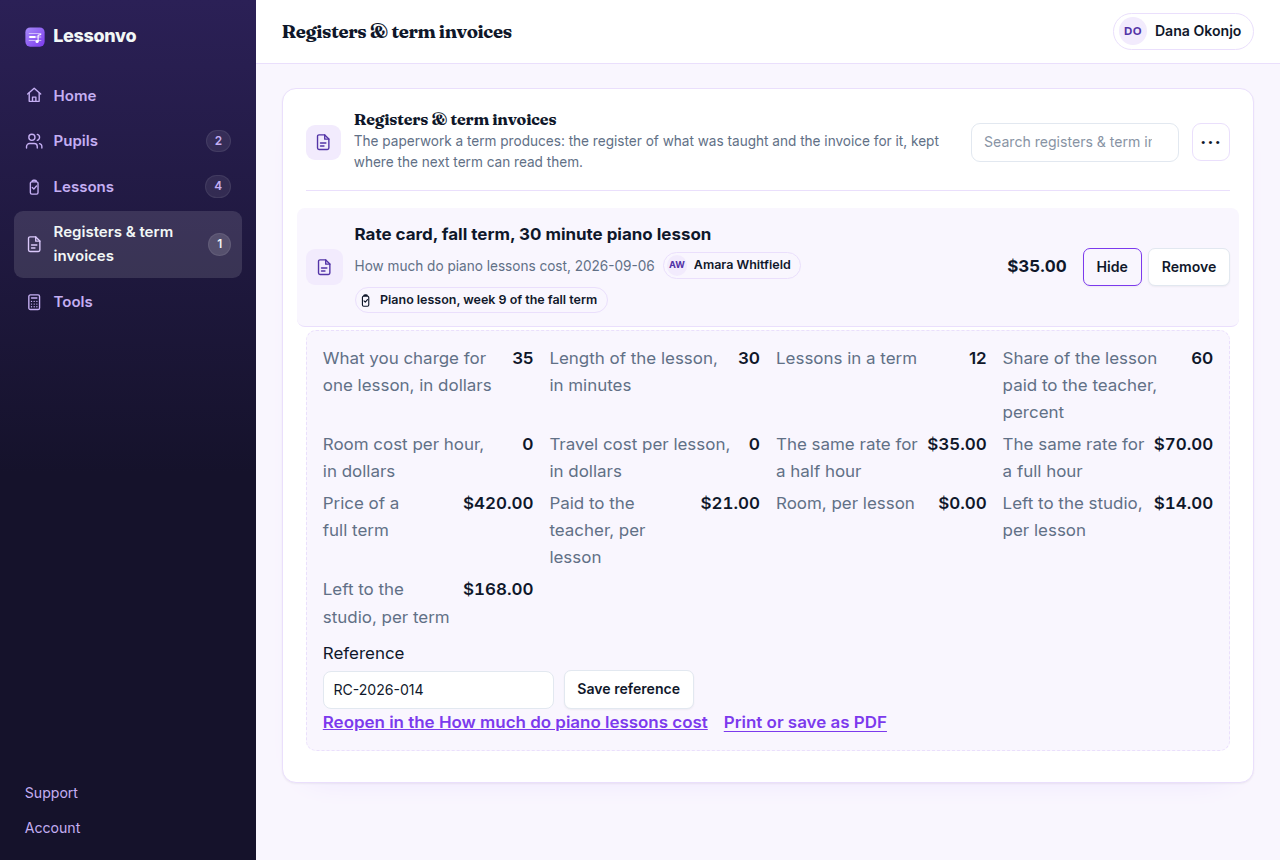
How much do piano lessons cost is the question a studio has to answer twice: once for the parent asking, and once for itself, because the rate that sounds normal in a town is not always a rate that leaves anything behind. This rate card works it from your own figures rather than a published average. Put in the length of the lesson, the number of lessons in a term, the rate you charge or are considering, the share that goes to the teacher who teaches it, what the room costs for the hour and the travel involved, and it returns the rate per half hour and per hour, the price of a whole term, and what is left per lesson and per term once the split, the room and the travel are paid.
Where the constants in this tool come from
What a studio owner asks before running the How much do piano lessons cost
How much do piano lessons cost?
It depends on three things this sheet asks you for: the length of the lesson, whether the teacher is paid a share or a wage, and whether the room is yours or rented. Rather than repeat an average that fits no studio, the sheet prices YOUR lesson: enter the half hour, the term weeks and the split, and it prints the lesson price, the term price and the margin left.
Should I price by the lesson or by the term?
Price the lesson and bill the term. A per lesson figure is what a parent compares, a term figure is what your bank sees, and the sheet prints both from the same inputs so you can quote one without losing sight of the other.
What should the teacher's split be?
That is your decision and it varies with whether the teacher brings their own pupils and whose room they use. The sheet takes whatever split you set and shows what is left after it, which is the number worth arguing about before you agree a rate.
Does the sheet publish what other studios charge?
No. This site publishes no teacher's prices and no studio's fees. It works out yours from your figures, and prints the method beside them so you can check the arithmetic.
Is what the sheet leaves me the same as what I keep?
No, and the gap is worth knowing before you set a rate. The sheet stops at what is left after the teacher's split, the room and the travel, which is the studio's margin, not take-home pay. A self-employed teacher still owes self-employment tax on the net earnings under it: the IRS puts that rate at 15.3 percent, being 12.4 percent for social security and 2.9 percent for Medicare, before any income tax. Work the margin here first, then take it to whoever does your return.
Lessonvo Pro
Keeping the register between terms
Upgrading turns the sheet into the register. The rate you settled on becomes the rate on the pupil's record; each lesson in the timetable is marked taught, missed or made up on the day; and the term invoice adds up what was actually taught rather than what was planned. Export is always available, so the register and the invoice history are yours whether or not you stay.
- Keep the rate you worked out, so next term starts from it instead of from a blank sheet.
- Put this term's rate next to last term's, or a thirty minute lesson next to a forty five, and see the difference.
- Print the sheet with the studio's name on it and without ours.
- Send the term invoice or a lesson reminder to a parent from the record it came from.
- Connect the studio's own Stripe account so parents can pay the term invoice.
- Connect the bookkeeping the studio already files with, so the term's income lands there.
$16per month, whole team
Start Lessonvo Pro Free for 14 days. No card needed. PricingThe first 14 days are free and no card is asked for. Add a card during the trial and the first charge is on the day it ends; do not, and your workspace becomes read-only with nothing deleted. Lessonvo Pro is $16 a month and renews monthly at $16 a month until you cancel. The price and the renewal date are shown before you pay.